Phones answered 24/7Flint, MI(855) 974-4733
Free quote (855) 974-4733
Serving Genesee County

Sealing mice out of a Flint house, opening by opening

The physical half of rodent work: find every gap a mouse can use, close it with material a mouse cannot chew through, and record what was done.

  • Mice and rats indoors
  • Fall invaders
  • Termite inspections

Get a fast quote

Fastest: call (855) 974-4733. Or send this and we call you back.

Mouse Exclusion

Mouse Exclusion and Sealing: what it covers

Quick answer

Exclusion means closing the building rather than treating the animal. A technician surveys the exterior and the lowest level of a Flint house for gaps at the sill line, utility penetrations, window wells and doors, then seals them with materials rodents cannot work through. It is the part of rodent control that keeps working after the traps come out.

Mouse Exclusion and Sealing illustration for Flint, MI

Trapping clears the mice that are already inside. Sealing decides whether more arrive next month. Both matter, but only one of them is permanent, and in a neighborhood where nearby structures may be standing empty, the sealing is the part that protects the house on its own terms rather than depending on what the lot next door does.

A house mouse needs very little. A gap at the base of a garage door, a worn corner of a basement window frame, the hole left where an old television cable came through the block: any of these is enough. The Michigan State University Extension advice on keeping overwintering insects out of a building is the same advice that works for mice, and it comes down to caulk, weather stripping and door sweeps, applied before the animals start looking.

Service area
Flint & Genesee County
Availability
Phones answered 24/7
Warning signs

Signs you need mouse exclusion and sealing

Working at the sill line means kneeling in soil, reaching into window wells and handling cut metal mesh, so wear gloves and eye protection if you take on part of the list yourself. Do not reach blindly into a void or a well you cannot see into. Leave anything near a gas meter, an electrical service entrance or an energized panel alone and let a technician handle those penetrations.

  • Droppings appearing again a few weeks after a previous trapping effort finished
  • A gap of a quarter inch or more under an exterior or garage door when it is closed
  • Daylight visible from inside the basement along the top of the foundation wall
  • Loose, missing or chewed trim around a pipe, conduit or vent where it passes through a wall
  • A basement window frame that has rotted, shrunk or pulled away from the masonry
  • Soil, leaves and debris filling a window well up to the level of the frame
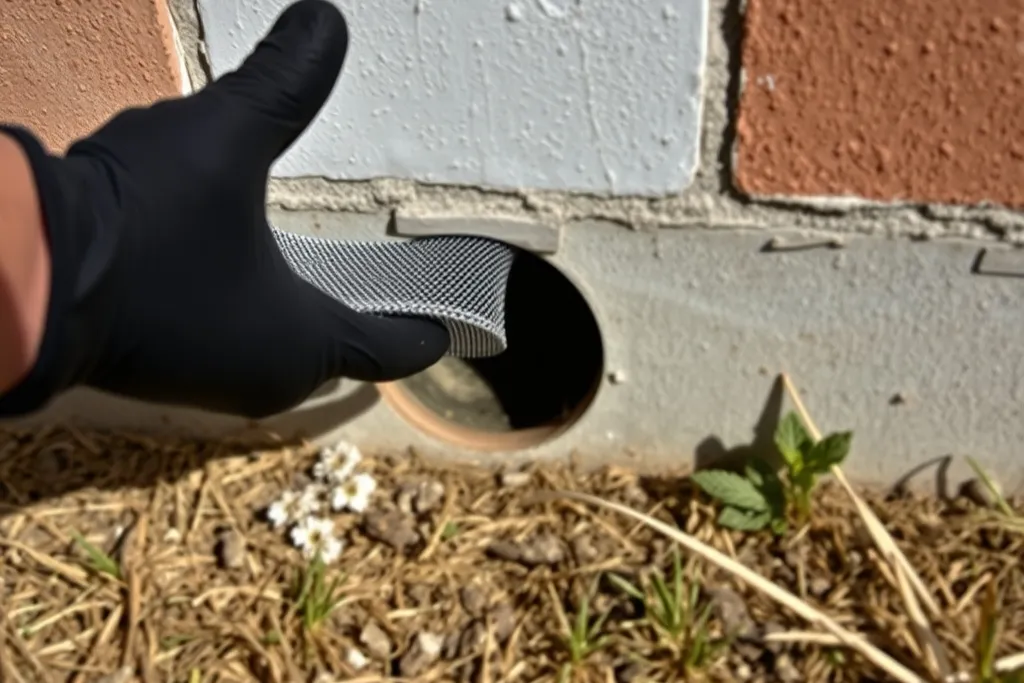
A gloved hand packing metal mesh into a gap where a pipe passes through a block foundation wall.
An illustration of exclusion work at a pipe penetration, shown as a general example.Generated illustration of a Michigan house and yard of the kind described on this site. It is not a photograph of a job this company has completed.
Our process

How our mouse exclusion and sealing visit works

  1. Survey the exterior at ground level

    The technician works the whole perimeter on hands and knees where necessary, following the line where the frame sits on the foundation. Siding corners, brick mortar joints, dryer and bath vents, hose bibs and meter penetrations all get checked individually. Each opening is noted with its location and its rough size so the material list can be built from facts.

  2. Survey the basement and the rim joist from inside

    From inside, the same line reads differently. With the lights off, daylight shows through gaps that nobody can see from the yard, and the rim joist cavity above the foundation wall is the single most productive place to look in an older house. Plumbing chases and the furnace flue get the same attention.

  3. Check the doors and the garage

    Doors are the most common failure and the easiest fix. Thresholds, sweeps, weather stripping and the corners where a garage door meets its jamb are measured against the door actually closed, not the door standing open. An attached garage is treated as part of the house, because the wall between them is rarely sealed.

  4. Agree the scope and the price

    You get the list of openings, what each one needs, and a price before any work starts. Some items are a technician's job and some are honestly yours, and the list says which is which. Nothing on a wall is cut, drilled or filled until you have approved it.

  5. Seal with material that holds

    Sealing matches the opening. Metal mesh or hardware cloth backs larger holes, a dense metallic mesh packs irregular gaps around pipes, mortar or masonry patch closes block work, and sealant finishes the edges rather than carrying the load. Foam alone is not treated as a rodent barrier, because a mouse can chew it.

  6. Record the work and plan a review

    What was sealed, where, and with what goes into a written record, which matters if the activity resumes and someone has to work out where. A review some weeks later looks at the completed work and the monitors, since a house settles, materials shift, and the yard changes with the seasons.

Job stories

Typical jobs for mouse exclusion and sealing

Typical job
Illustration: Typical call: droppings behind a kitchen cupboard in north Flint

Typical call: droppings behind a kitchen cupboard in north Flint

What homeowners notice
After the first cold nights a household finds droppings at the back of a base cupboard and hears light scratching in the wall behind it. There is a cleared lot two doors along the street.
What we do
The technician walks the outside at ground level first, finds an oversized hole where a water line enters the block and a garage door seal that no longer meets the slab on one side, then checks the basement rim above both. Mesh is packed into the pipe gap and finished, and the door seal is listed as a repair.
What to expect
The report lists each opening, which were closed on the visit and which need another trade, and sets out a short monitoring period to confirm nothing is still moving inside.

depends on the number of openings found typical visit

How small an opening actually matters

A house mouse can pass through a gap far narrower than most people assume, and it can enlarge a soft one by gnawing. The practical rule used on a survey is that anything a pencil fits into is worth closing, and anything soft enough to chew counts as open regardless of size.

Mice are climbers as well as squeezers. A brick wall, a downspout and a vine all serve as a route upward, so a survey does not stop at knee height. Vents, soffit returns and the gap where a porch roof meets the wall are all candidates, and in an older house they are often the openings nobody has looked at in decades.

That is why the survey is slow and the sealing is fast. Finding the gaps is most of the job. Once they are listed, closing them is ordinary work with ordinary materials, and the hardest part is the discipline of doing all of them rather than the three that were easy to reach.

Why foam and steel wool are not the answer

Expanding foam is a weather seal, not a rodent barrier, and a mouse will open it. Ordinary steel wool rusts away in a damp basement wall within a season or two. Both leave a homeowner believing a hole is closed when it has quietly reopened.

The materials that hold are mechanical: galvanized hardware cloth cut and fitted, a dense corrosion-resistant metallic mesh packed tight into irregular gaps, mortar or patching compound in masonry, sheet metal over a chewed wooden edge. Sealant and foam then go over the top to finish the detail and stop drafts.

There is a maintenance element too. Materials at ground level take abuse from water, frost and lawn equipment, and a seal that was perfect in October can be loose by April. A later review exists for exactly that reason, and it is a short visit rather than a repeat of the whole survey.

What older Flint construction tends to offer a mouse

Most houses here predate 1960. That generally means a wood-framed basement ceiling sitting on a block or poured wall, original window openings at or below grade, and utility penetrations cut and recut as services were replaced over seventy years.

The rim joist is the usual culprit. Where the floor frame rests on the foundation there is a long cavity running the whole way around the building, and in a house of this age it is rarely sealed and often not even insulated. A mouse entering there is inside the structure immediately, with access to every wall cavity on the ground floor.

The second is the window well. Wells settle, fill with debris and hold water, and the frame above them rots at its lowest corner first. Clearing the well, replacing the rotted section and fitting mesh addresses the opening and the moisture at the same time, which is the kind of repair that pays for itself twice.

Sealing and moisture work together

The same gaps that let mice in let water and cold air in, so exclusion work usually improves a basement in more than one way. It also removes the damp conditions that draw crickets, ants and other insects toward the lowest level of a building.

Heavy rain has flooded basements across Genesee County more than once, and a basement that takes water also tends to be one with openings at grade. Regrading a downspout discharge, clearing a window well and sealing the sill line are a single afternoon's set of tasks that address water and rodents together.

A technician will say when the right answer is not sealing at all. If the structural wood at an opening has gone soft, a patch over it is cosmetic; that item goes on the list as a repair to arrange before the seal is worth making. Being told that is more useful than a tidy-looking job over bad wood.

What exclusion does not do

Sealing closes a building; it does not remove animals already inside it, and it should not be completed while something is living in a wall. The order of operations matters, and a careful technician will say so before taking a sealing-only job.

Closing a house with mice in the wall voids traps them in the structure, which produces odor and more chewing rather than fewer problems. Where there is current activity, trapping runs first or alongside, and the final seals go in once the monitors have been quiet for a stretch.

Exclusion also does not cover attic wildlife or anything larger than a rat. If the survey turns up evidence of something bigger at the roofline, that is said plainly and treated as a separate matter, rather than being quietly included in a mouse job.

Options

Types and options for mouse exclusion and sealing

Sealing after a trapping job

The common sequence. Trapping has ended the indoor activity and the exclusion work closes the route so the next mouse has nowhere to go. Done in this order, the sealing can be aimed at proven entry points rather than every theoretical one, which keeps the scope sensible.

Preventive sealing before fall

Work done in late summer or early fall, before the first cold nights push mice toward buildings. This is the cheapest version of the job in effort terms, because nothing is living in the walls yet and nothing has to be trapped out of a space that has just been closed.

Sealing a house next to an empty structure

Where a neighboring property stands empty, the pressure does not stop and no treatment inside your house changes it. Sealing is the only measure that works on your side of the property line, and the survey here is deliberately thorough, including the garage and any outbuilding.

Genesee County

Why mouse exclusion and sealing is different in Mid-Michigan

Rodents move between empty and occupied properties, which is why a house's own openings matter more here than a treatment schedule does. The City of Flint has publicly described how nuisance animals can overrun abandoned structures and become a problem for a whole neighborhood, and in 2023 the city's blight office arranged for pest control work at blighted properties ahead of demolition, alongside the Genesee County Land Bank. Demolition continues. None of that changes what one homeowner can control, which is the envelope of their own building.

The work differs by area in ways worth knowing. City bungalows in North, Northwest and South Flint typically present a block foundation, a wood rim joist and window wells at grade. Mount Morris, Clio and Swartz Creek add detached garages and outbuildings that are often the real entry point. Newer Grand Blanc housing has tighter envelopes but the same vulnerable utility penetrations.

Still stuck? We pick up 24/7.

If it's an emergency, call now. For non-urgent mouse exclusion and sealing, send the form and we'll call you back.

Related

Mouse Trapping and Monitoring

Removing the mice that are in the building now, with placement based on where they actually travel and return visits that confirm the activity has stopped.

Rodent Proofing Near Vacant Properties

A hardening job for the house you own, aimed at steady rodent pressure from a nearby empty building that no treatment on your side can switch off.

Rat Control

Work aimed at a burrowing rodent that lives outside and feeds wherever it can: find the burrows, read the runways, trap, and take away the shelter.

Guides

Read before you book

FAQ

Mouse Exclusion and Sealing FAQs

Should sealing happen before or after trapping?

Trapping first, or both at once, with the last seals going in after the monitors go quiet. Closing a house that still has mice in the walls keeps them inside, which is worse than the original problem.

Can I just do the sealing myself?

Parts of it, yes, and the survey list will say which parts are reasonable homeowner work. Door sweeps, weather stripping and clearing a window well are straightforward. Mesh around a gas penetration or work above head height is better left alone.

How long does exclusion work last?

Mechanical seals in sound material last for years. What fails is the detail at ground level, where water and frost work on it, and anywhere the underlying wood was already soft. A later review checks those points rather than the whole house.

Does it help if my neighbor's house is empty?

It is the only thing that helps. You cannot change the conditions on another property, but a sealed building stops being an option regardless of what is next door. The guide on empty houses and rodents goes through this.

Will I need to open up walls?

Usually not. Nearly all of the work is at the sill line, at penetrations and at doors, all of which are reachable from outside or from the basement. If a survey does point to something inside a finished wall, you are told before anything is cut.

What about the attached garage?

It is treated as part of the house. Garage doors and thresholds are among the most common openings found, and the wall between a garage and the living space is often unsealed where plumbing and wiring pass through it. For a survey of your own openings, (855) 974-4733 is answered around the clock.

WhatsApp